
Culturally Responsive Anti-racist Equitable (CARE) - InFORMING
Learning Playlists > Culturally Responsive Anti-racist Equitable (CARE) – Informing
In a culturally responsive school or district, students’, families’, and educators’ cultures are included in all aspects of supports and services that promote well-being and mental health. Anti-racist policies and practices promote equity and oppose racism and other forms of oppression. Equitable schools and districts provide the climate and resources that enable all students and educators to perform at their highest level. Culturally responsive, anti-racist and equitable (CARE) schools and districts embrace cultural differences and assets; use cultural knowledge to promote wellness and academic success; mediate power imbalances based on cultural identities; and work to dismantle systems of injustice.
The resources below focus on building a positive school climate and are recommended for schools or districts that have started to do some exploration in this area and wondering what to do next. This Informing playlist offers tools and resources to support schools in strengthening and contextualizing their equity efforts. Teams in this stage are developing a deeper understanding of bias, disproportionality, and belonging, moving from isolated strategies to integrated, schoolwide practices. Reflective listening, collaborative planning, and community partnership are central themes, as schools examine real-world examples and engage in structured reflection on the impact of their actions. Resources are designed to support adapting practices to unique community contexts and ensure equity work is rooted in lived experience and collective ownership.
Click here for our Action Planning Guide to help you through the process of creating an action plan that will help your school move towards becoming a more resilience-supportive school community.
- Culturally Responsive Anti-Racist & Equitable (CARE) Assessment

- 45 mins
This assessment from the National Center of School Mental Health is recommended for all stages of readiness in this work. This assessment contains five domains: 1) Teaming and Collaboration; 2) School Climate; 3) School Discipline; 4) Curricula and Teaching; and 5) Professional Development. Each indicator includes a few ways schools or districts may demonstrate success in each area. The examples included in the assessment are not exhaustive, but illustrative, and ratings in each domain can be used as a starting place for quality improvement initiatives. This assessment tool provides suggestions for action planning that can be tailored to meet your school’s needs. A team approach with broad and diverse participation in this process ensures meaningful assessment, successful planning, and implementation. Click here for the Assessment Guide to help your team through this process.
You can take the CARE Assessment on the RSSI site at www.rss-illinois.net. Download a copy of the assessment here. For more information about the School Mental Health Quality Assessment, visit the SHAPE System at the National Center for School Mental Health by clicking here.

- 90 mins
These four short courses provide a solid foundation for districts, schools and teams wanting to expand their understanding of the intersection between trauma and racism. The courses are broken down into the three levels of racism described in Dr. Camara Jones’ framework: Institutional, internalized, and personally mediated. Each course provides a deeper dive into the impact of racism on trauma, as well as strategies schools and districts can put into place.
Link to Learning Series or links to the four separate courses:
- HR Toolkit for Racial Equity (toolkit)

This resource comes from W.K. Kellogg Foundation’s work that includes recommended tools and resources for implementing racial equity strategies as part of a human resources function. This resource can be valuable to human resources and culture and equity professionals. It may also be useful to any leader doing internal organizational transformation work in school communities.
- 25 mins
- New Mexico Community Schools: Improving Student Opportunities and Outcomes (report)

This brief from the Learning Policy Institute highlights lessons learned from New Mexico’s investment in community schools. Drawing on profiles of three sites that received state implementation grants, we find that community schools implementing the key practices at the center of New Mexico’s community schools framework are seeing improvement across a range of indicators, including growth in test scores, increased graduation rates, reduced chronic absence, increased student engagement and connectedness, improved school climate, greater access to mental and physical health care, and stronger family engagement. Key to achieving these outcomes were state investments to support hiring school coordinators and to provide professional development and technical assistance.
New Mexico Community Schools Improving Student Opportunities and Outcomes
- 20 mins
- Cultivating Relationships in Secondary Schools (report)

The science of learning and development demonstrates the value of positive relationships for student success and well-being. This brief describes structures that secondary schools can integrate to cultivate conditions that enable healthy attachments to grow. Specifically, it highlights structures that can foster personal teacher–student relationships, including those that create small learning communities, promote safety and belonging, support culturally sustaining and relevant education, and foster student voice and agency. In addition, it describes structures that enable relationship-building between and among staff and families so that relationships can become more fully embedded into a school’s culture and fabric. School structures can create opportunities for relationships to develop, but those structures are only as powerful as the interactions within them.
Cultivating Relationships in Secondary Schools: Structures That Matter
- 20 mins
- Building a Culture of Joyful Learning (report)

Research shows that students who feel known and valued are more prepared to meaningfully engage in learning. Students who experience a sense of belonging have better self-esteem, higher rates of classroom participation, and higher academic achievement (Korpershoek, 2018). As a result of creating a positive school climate for both students and educators, the elementary school featured in this report had the conditions in place to make rapid academic gains. When educators implemented the instructional improvements described in this case study of improvement at the Harvard-Kent Elementary School, student proficiency improved dramatically because children were in the right mindset for learning.
- 12 mins
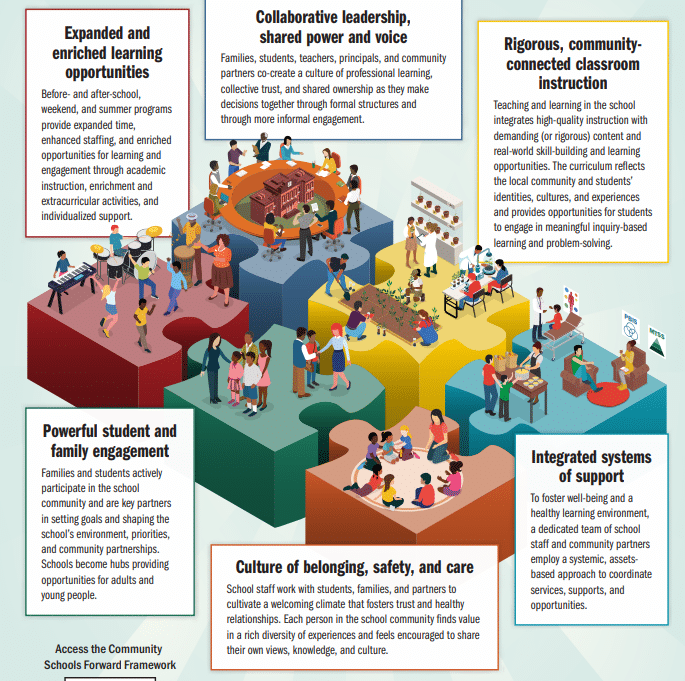
- Key Practices for Community Schools Transformation (infographic)
- 5 mins
The six key practices for school transformation are illustrated on this infographic from the Community Schools Forward Framework, informed by both research and practice. The framework shows the integrated nature of the key practices and emphasizes the enabling conditions (i.e., trusting relationships, inclusive decision-making, a shared vision, and actionable data) and supportive infrastructure that must be in place for effective implementation.
Community Schools Forward – Fact Sheet and Infographic
- Building a Culture of Faculty and Staff Compassion Resilience (toolkit)

A trauma-informed, resilience-oriented school honors the need to prioritize the well-being of all staff. Compassion fatigue and burnout are increasingly prevalent when staff members work daily with students who are impacted by trauma and toxic stress. This reading aims to increase awareness and understanding of compassion fatigue, burnout, and compassion resilience. Learn about how to encourage wellness assessment and seek feedback from staff on resilient culture, implement individual and district-wide adaptations to promote resilience in staff.
Section 3: Building a culture of faculty and staff compassion resilience
For the entire Trauma Informed Resilience Oriented Schools Toolkit, click on this link.
- 10 mins
- How Caregivers & Teachers Can Work Together: 5 Family Engagement Ideas (reading + video)

This is part of Panorama’s Celebrating Resilience webinar programming, which features a panel of experts who explore how districts are adapting family engagement frameworks to today’s context. Decades of research outline a clear need for parental engagement in a child’s education. When families are engaged in school, their children are more likely to succeed. At a more holistic level, many studies support the importance of partnerships among families, schools, and the broader community. Educators and administrators also play a role in making family-school partnerships work. When schools elevate family members as true partners and the experts that they are students benefit significantly.
Click the link for five family engagement ideas: How Caregivers & Teachers Can Work Together: 5 Family Engagement Ideas
- 60 mins
- The Importance of Teaching and Learning Conditions on Teacher Retention and School Performance (reading)

This brief draws on a study of teacher working conditions and their relationship to teacher retention and school performance in North Carolina. It is part of a series of studies conducted by the Learning Policy Institute—in collaboration with WestEd and the Friday Institute for Educational Innovation at North Carolina State University—as part of an action plan developed to inform ongoing efforts to ensure compliance with the North Carolina Supreme Court’s decision in Leandro v. the State of North Carolina. That case affirmed the state’s constitutional responsibility to provide every student an equal opportunity for a sound basic education, including access to qualified teachers and administrators. Requested by the court in conjunction with both plaintiffs and defendants, the action plan aims to identify root causes of current inequalities and evidence-based solutions to meet the constitutional standard.
- 12 mins
- Reducing Barriers to Family Engagement (toolkit)

This toolkit from Panorama outlines ways school districts can understand and address common barriers to engagement with families. It also provides information on the Panorama Family-School Relationships Survey, which uses questions to identify what family members perceive as obstacles to engaging with their child’s school, schools can set goals and improve family-school partnerships in targeted, data-driven ways.
Link to toolkit, which includes survey Family Engagement Toolkit | Panorama Education
- 30 mins
